
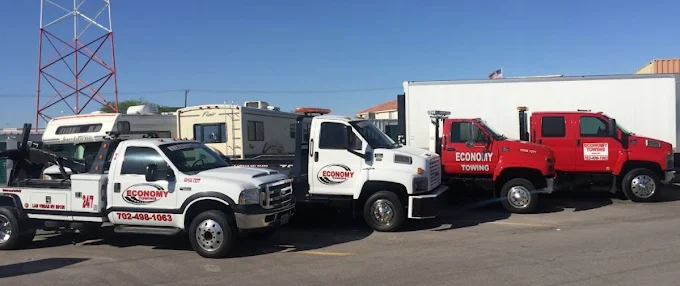
There is no price list on this page, and that is deliberate. The cost of a tow in Las Vegas is not one number, it is a small set of components that combine differently on every job, and any figure published in advance would be wrong for most of the people reading it.
What is useful is knowing what those components are, which of them your situation triggers, and what a quote should look like when it comes back. Then you can tell a fair number from an unfair one, which is the actual question.
The components a tow charge is built from
Almost every tow invoice in this trade is assembled from the same parts. Not all of them apply to every job.
- The base charge for the truck attending and loading. Sometimes called a hook or a load charge. It covers the truck coming out and the vehicle being connected or put on the deck.
- Distance. Usually the loaded miles from where the vehicle is to where it is going. On jobs a long way outside the valley, the truck’s return leg is part of the work whether it appears as a line or is folded into the rate.
- Vehicle class. Which truck can do the job at all. A box truck cannot go on light duty equipment, and the class sets the floor for everything else.
- Extra equipment or labour. Dollies, skates, a second operator, rigging, or anything else the job needs that a straight load does not.
- Winching and recovery time. Any work needed to get the vehicle back onto a surface a truck can use, which is separate from the tow that follows it.
- Waiting time. Where the truck arrives and cannot work: nobody present, a gate not open, a vehicle blocked in, a shop closed at the far end.
- Conditions at the destination. A closed shop, an access restriction, or a vehicle that has to be held somewhere before it can be delivered.
Companies structure and name these differently. What matters is that they are separable, and that you are told which ones apply before the work happens rather than reading them for the first time afterwards.
Distance is not the biggest variable people think it is
Most people assume mileage dominates. On a short urban move it usually does not: the base charge for the truck attending is the larger part, because a truck and an operator turning out has a cost that does not shrink with a shorter trip.
Distance becomes the dominant component in one situation, which is a job that takes the truck a long way out of the valley. There, the vehicle is carried the whole way and the truck drives back, so the job is a round trip regardless of how it is described. That is worth understanding before you call from a desert corridor rather than after.
Vehicle class decides which truck, and the truck decides the floor
This is the component people underestimate most.
Cars, crossovers and half-ton pickups are light duty work, covered under light duty towing. Box trucks, shuttles and dual-rear-wheel pickups sit a class above. Tractors, loaded trailers, motorhomes on a chassis and anything that has left the pavement under its own weight belong with heavy duty towing, where the equipment is larger and so is everything that follows from it.
Drivetrain and condition can force a class or a method independently of size. An all-wheel-drive car has to be carried or run on dollies, a lowered car needs particular loading equipment, and a vehicle that will not roll needs winching and skates. Those are equipment decisions, and the reasoning behind them is set out in our guide to flatbed versus wheel lift towing.
A straight hook and a recovery are not the same job
A straight tow is a vehicle sitting on a surface the truck can reach, loaded and moved. Predictable, and the components above cover it.
A recovery is different work. A vehicle in a wash, off a shoulder, down an embankment, in soft ground or on its side has to be brought back to a working surface first, and that depends on angle, anchor points, ground condition, how much of the vehicle is buried and whether more than one truck is needed. It takes time that cannot be estimated accurately from a phone description, which is why a recovery is usually quoted differently from a tow, often on the time and equipment actually used.
The honest version of that conversation is an operator telling you what they expect to find and what would change it, rather than a firm number over the phone for a job nobody has seen.
The cost of a tow in Las Vegas when someone else is paying
Plenty of tows are paid by a third party: an insurer, a motor club, a dealer, a warranty provider, a fleet account. That changes the paperwork more than the work.
Two things are worth knowing. Where a club or an insurer has an arrangement with the company, the terms of that arrangement apply and the driver at the roadside cannot vary them. And where the coverage has limits, on distance or on what is included, the part outside those limits is normally yours. Ask the payer what their coverage covers before the truck is dispatched, not after the vehicle has been moved.
If the fault turns out to be a battery, a lockout, a flat or fuel, the visit is roadside assistance rather than a tow, which is a smaller job with a different structure. It is worth asking that question first.
What a good quote looks like, and what a bad one looks like
A good quote separates the components, states which ones apply to your situation, and says plainly what would change it: the vehicle turning out not to roll, access being blocked, the destination being closed, or a straightforward load becoming a recovery. It also names the destination and says what happens if the vehicle arrives outside opening hours.
The warning signs are consistent. An operator who will not break the number down. A number quoted before anyone has asked about drivetrain, whether the vehicle rolls, or exactly where it is standing. An unsolicited truck that has appeared at a scene nobody called it to. And an invoice afterwards that is one figure with no lines, which is a document you cannot check even if it happens to be fair.
You can also make the job simpler, and simpler jobs have fewer components. Give accurate information on the call. Make sure the vehicle is accessible and someone is there. Decide the destination before the truck arrives. How dispatch uses that information is covered in our guide to how a dispatch decision gets made, and the full set of service lines is on our towing and transport services page. To ask about a specific situation, use contact us.
Frequently asked questions
Why will nobody give me a fixed price for a tow over the phone?
Because the price depends on things that have not been established yet: which truck can do the job, whether the vehicle rolls and steers, where exactly it is standing, whether anything has to be winched, and where it is going. A firm number given before those are known is either padded to cover the unknowns or is about to change. What you should get instead is the components that apply, and a clear statement of what would alter them.
Does a tow cost more at night or at the weekend?
Many operators structure their charges differently outside normal working hours, and that is a question to ask directly when you call rather than to assume in either direction. It should be stated up front as part of the breakdown, not appear afterwards as a surprise line on an invoice.
Is mileage the main thing I am paying for?
Usually not, on a short move inside the valley. The base charge for the truck and operator attending and loading the vehicle is generally the larger part, because turning a truck out costs the same whether the trip is two miles or five. Distance dominates on long jobs outside the valley, where the vehicle is carried the whole way and the truck drives back.
Why is a recovery quoted differently from a tow?
Because it is different work with an unpredictable duration. Getting a vehicle out of a wash, off a soft shoulder or back onto the pavement depends on angle, ground condition, anchor points and sometimes a second truck, and none of that can be assessed accurately from a phone call. Recoveries are commonly charged on the time and equipment actually used, and a good operator will tell you what they expect and what would change it.
My insurance is paying. Do I still need to ask about the charge?
Yes. Coverage usually has limits, on distance or on what is included, and anything outside those limits is normally yours to settle. Where an insurer or motor club has an arrangement with the company, its terms apply and the driver at the roadside cannot change them. Ask the payer what is covered before the truck is dispatched rather than after the vehicle has moved.