
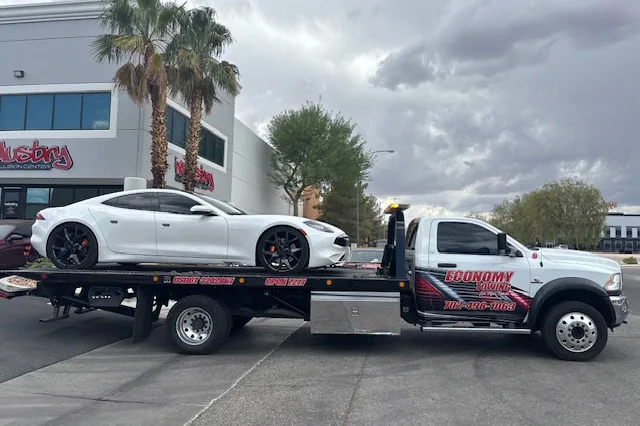
A car that will not shift into neutral is a specific kind of stuck. It is not a breakdown in the usual sense, the car may look completely fine, and it cannot be rolled, pushed or winched onto a bed without extra equipment.
It is also common, and the fix on site is usually straightforward once the driver knows what he is dealing with. The thing that wastes time is finding out on arrival.
Why a car will not go into neutral
- A dead battery. This is the most frequent cause on a modern car. The shift interlock is electrically released, so with no power the lever will not come out of park. In a climate as hard on batteries as this one, it is an everyday call, and the background is in dead battery jump start in Las Vegas after extreme heat.
- A failed brake light switch or shift interlock solenoid. The car has power and still will not release, because the system that confirms your foot is on the brake is not working.
- A seized parking brake. The shifter moves and the wheels do not. Common on a car that has sat for a long time, and more common in a damp or dusty environment.
- A seized or locked wheel, from a frozen caliper, a failed bearing or collision damage.
- A seized engine or transmission, which on some vehicles prevents shifting entirely.
- Collision damage to the shifter, the cable or the linkage.
- A failed electronic shifter, now common on vehicles where the selector is a switch rather than a mechanical lever.
Each of these looks identical from the curb and each needs something different.
What the driver can do on site
- Jump the battery. When the cause is a flat battery, restoring power releases the interlock and the car shifts normally. That turns the whole job into a routine tow or sometimes removes the need for one, as covered in jump start service in Las Vegas.
- Use the shift lock override. Most automatics have a manual override, frequently a slot near the shifter covered by a small cap, that releases park mechanically. Where it exists and the rest of the drivetrain is free, that solves it.
- Load it as it is. A flatbed can winch a car in park onto the bed using skates or dollies under the locked wheels. It takes longer and it works.
- Use skates or dollies. For a seized wheel or a locked parking brake, skates go under the affected wheels so the car can be moved regardless of what the drivetrain is doing. That equipment has to be on the truck when it arrives.
Why this changes the equipment sent
A car in park with four free-rolling wheels and a car with a seized wheel are different jobs. A car that rolls can be winched up a bed, with the wheels turning normally. A car that does not roll has to be dragged, which is not acceptable on anything with tires worth keeping, or lifted onto skates so it can roll.
Skates and dollies are not on every truck at every moment. Saying on the call that the car will not go into neutral, and better still why you think that is, means the right truck shows up once. The general equipment distinctions are in dolly towing service and flatbed versus wheel lift towing.
How to tell which problem you have
Three checks take a minute and they narrow it considerably.
- Do the dash lights come on? No lights, or dim lights with a slow crank, points to the battery, which is the easy case.
- Do the brake lights work? Have someone look while you press the pedal. No brake lights with a healthy battery points at the brake light switch, which also controls the shift interlock on many vehicles.
- Does the car move at all when pushed, with the brake released? If the shifter does come out of park and the car still will not budge, the problem is a brake or a wheel rather than the shifter.
You do not have to diagnose it. Passing these three observations to dispatch is worth more than a guess at a cause.
Parking brakes that will not release
A seized parking brake is its own category and a common one on cars that have sat. Cables corrode, shoes rust to the drum, and electronic parking brakes fail with a flat battery in the same way a shift interlock does. In each case the shifter may work perfectly while the car still will not move.
This matters for anyone storing a vehicle. A car parked for a long period with the parking brake applied, particularly after being washed or driven in rain, is a candidate for exactly this. Leaving it in gear or in park with chocks instead is a practice worth adopting for long storage.
All wheel drive makes it stricter
On an all wheel drive vehicle that cannot be put in neutral, the only correct answer is to lift all four wheels, which means a flatbed or a wheel lift with dollies. That is not a precaution, it is drivetrain protection, and the reasoning is in towing all wheel drive and four wheel drive vehicles.
What to say when you call
“It will not go into neutral” is the headline, and then four specifics. Whether the dash lights come on. Whether the shifter physically moves. Whether the wheels roll when pushed. And whether it is front, rear or all wheel drive.
Add the access, since a tight garage or a parking structure changes what is possible, as covered in underground parking towing. That set of answers lets dispatch send a truck with skates or dollies on it if it needs them, which is the difference between one visit and two. The general flow is described in towing service in Las Vegas, what to expect from dispatch to drop-off.
Frequently asked questions
Why will my car not come out of park?
Most often a dead battery, because the shift interlock is released electrically and without power the lever stays locked. Other causes are a failed brake light switch or interlock solenoid, a seized parking brake, a locked wheel, collision damage to the shifter or linkage, and failure of an electronic shifter. They look identical from outside and need different responses.
Can a car still be towed if it will not shift into neutral?
Yes. A flatbed can winch it on using skates or dollies under the locked wheels, which lets the car roll regardless of what the drivetrain is doing. It takes longer than a routine load and the equipment has to be on the truck, so tell dispatch when you call rather than letting the driver find out.
Is there a manual release for the shifter?
Most automatics have a shift lock override, usually a small slot near the shifter under a removable cap, that releases park mechanically. Where it exists and nothing else is seized, that solves the problem on the spot. The owner’s manual shows the location, and a driver will normally check for it as a first step.
My shifter moves but the car will not budge. What is that?
A brake or a wheel rather than a shifter problem. The usual causes are a seized parking brake, which is common on cars that have sat, a frozen caliper, a failed wheel bearing, or collision damage. The car has to be put on skates to be moved, so mention that the wheels are locked when you call.
How do I avoid this when storing a car?
Avoid leaving the parking brake applied for long periods, especially after the car has been washed or driven in rain, since cables corrode and shoes rust to the drum. Leaving it in park or in gear with chocks is the safer practice. Keeping the battery maintained also prevents the most common version of the problem entirely.